Massachusetts Ballot Questions 2026

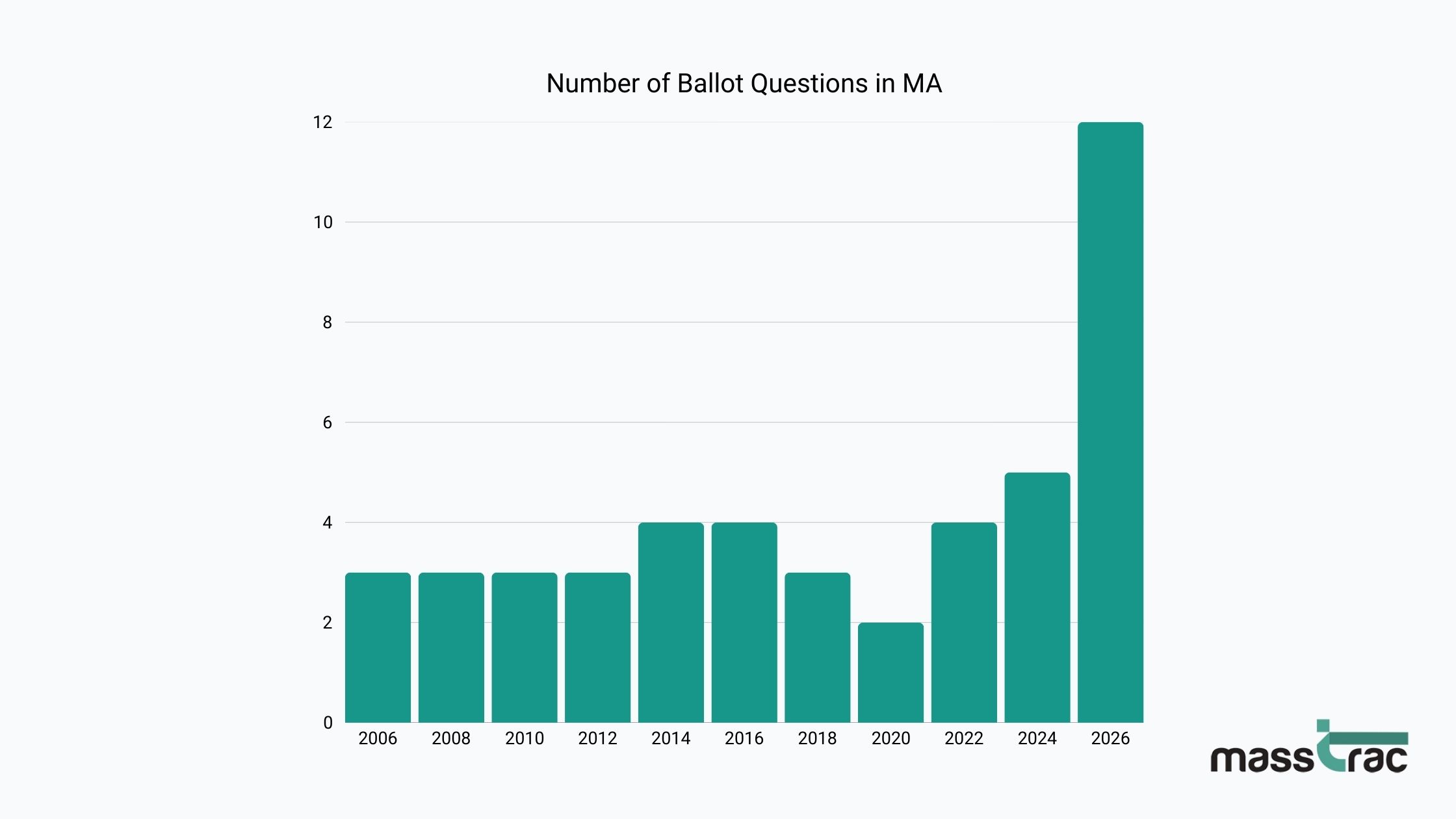
A record 44 ballot initiatives (40 potential laws and 4 potential Constitutional amendments), have cleared the Attorney General’s certification process and are now on track for the 2026 ballot.
As a way to circumvent Beacon Hill, groups put together ballot initiatives to pass laws. Depending on who you ask, the amount of ballot measures signals either the public’s frustration with Beacon Hill’s stagnation or special interest groups butting into the democratic process. Whichever camp you find yourself in, our policy experts have analyzed the top campaigns to watch.
How does the ballot process work?
A Petitioner prepares the initiative petition and collects signatures from at least 10 registered voters.
The Petition is submitted to the Attorney General's Office by the first Wednesday in August (typically in odd-numbered years).
The Attorney General's Office reviews the petition to determine if it meets constitutional requirements.
The Attorney General's Office certifies qualifying petitions by the first Wednesday in September.
Certified petitions are filed with the Secretary of State's Office.
Petitioners collect 74,574 signatures from registered voters.
Collected signatures are filed with local election officials for certification, 14 days before the first Wednesday in December.
Signed petitions are filed with the Secretary of State's Office by the first Wednesday in December.
If enough signatures are collected, the measure is sent to the Legislature in January of the next year.
Legislature reviews the measure and can pass it, propose a substitute, or take no action.
If the Legislature doesn't pass the measure by the first Wednesday in May, petitioners must collect 12,429 additional signatures.
Additional signatures are filed with local election officials for certification, 14 days before the first Wednesday in July.
Additional signatures are filed with the Secretary of State's Office by the first Wednesday in July.
After sufficient signatures are filed, the measure is placed on the ballot for the next statewide general election.
If the Legislature doesn't act, a majority of the first 10 signers can propose so-called "perfecting amendments" that don't change the substance of the measure, but refine it.
Perfecting amendments must be certified by the Attorney General's Office and filed with the Secretary of State by the first Wednesday in June.
For constitutional amendments, the petition must be approved by 25% of legislators in two consecutive legislative sessions.
Constitutional amendments that pass the Legislature don't require additional signatures before appearing on the ballot.
Key Campaigns to Watch
Stipend Reform: The campaign to overhaul legislative stipends says it collected 90,000 certified signatures. Organizers argue that up to $5 million in “loyalty pay” flows to favored legislators and seek to rein in what they call leadership-driven allocations. Top Democrats counter that stipends reflect extra responsibilities and help lawmakers treat their role as a career. This comes after the Boston Globe’s study on legislators’ salaries.
Starter Homes: This proposal aims to legalize smaller single-family homes (aka tiny homes or accessible dwelling units) in more residential zones by revising lot size, frontage, and infrastructure requirements. The committee says it gathered more than 100,000 signatures and anticipates 82,000 certified.
Rent Control: The “Keep Massachusetts Home” initiative reports over 124,000 raw signatures. The measure would cap annual rent increases so that rent could only rise by either the rate of inflation or 5 percent, whichever is lower. The rent in place as of January 31, 2026 would be used as the starting point for all future increases.
Nature for All: Seeking to generate $100 million annually for conservation efforts, this measure would divert sales tax revenue from sporting goods and outdoor gear into a fund for land and water resource protection, including indigenous cultural sites.
All-Party Primary: In an effort to democratize elections in the state, this question would eliminate separate party primaries and instead list all candidates from all parties on a single primary ballot, with the top two vote-getters advancing to the general election. The top two candidates could be of the same party.
Income Tax: This proposal would gradually reduce the state personal income tax rate from 5% to 4% over three years, starting at 4.67% in 2027, then 4.33% in 2028, and reaching 4% in 2029. The reduction would apply to all personal taxable income including wages, salaries, interest, and dividends.
Same-Day Voter Registration: This proposal, presented by Secretary of Commonwealth, Bill Galvin, would allow eligible voters to register to vote or update their address on Election Day by presenting proof of residency and signing an oath at their polling place. The registration would apply to both that day's election and all future elections, with the law taking effect on January 1, 2028.
Marijuana Recriminalization: This question aims to eliminate legal retail sales of recreational marijuana while still allowing adults 21 and older to possess up to 1 ounce and gift it to others. Recreational marijuana businesses would be shut down (though they could transition to medical dispensaries), and the state would return to regulating only medical marijuana through the Cannabis Control Commission, effective January 1, 2028.
Public Defenders Unionizing: This question would formally grant employees of the Committee for Public Counsel Services (CPCS), which provides legal representation to low-income defendants, the right to engage in collective bargaining with their employer. After reaching a collective bargaining agreement, CPCS would be required to request the necessary funding from the Governor to implement the agreement. SEIU Local 888, the organizers of the petition, argue that other state employees are entitled to unionize, but CPCS is not at this time.
Public Records: The Legislature and Governor’s Office are not subject to most public records laws in Massachusetts. This initiative aims to change that. Exempt records would include documents related to public policy development and communications between legislators and constituents when those communications involve requests for help with government benefits, services, or agencies.
Legislative Origins
One notable pattern with many of these campaigns is that many began as legislative proposals.
Starter Homes
The “Legalize Starter Homes” campaign sits on top of nearly a decade of incremental housing and zoning reforms rather than in a vacuum. Governor Charlie Baker signed a major housing bond bill in 2018, and the 2021 economic development bill introduced the MBTA Communities multifamily–zoning requirement and Housing Choice reforms to make it easier for municipalities to approve housing–friendly zoning changes.
Then, in 2024, Governor Maura Healey signed a sweeping housing bill that legalized accessory dwelling units statewide and fund infrastructure tied to housing production.
None of these laws went far enough to address the residential zoning restrictions in Massachusetts, according to the campaign. Against that backdrop, the starter–homes ballot initiative tries a more prescriptive statewide approach by requiring that modest single–family homes be allowed on smaller lots that meet basic infrastructure standards.
Rent Control
The rent control initiative is another campaign with roots stemming from Beacon Hill. In 1994, a law was passed banning rent control. Since then, legislators have filed multiple bills to partially undo that ban or give municipalities local options. Recent examples include:
HB1304 (2023–2024), An Act enabling local options for tenant protections, which would remove the statewide prohibition on rent control and allow cities and towns to adopt rent stabilization and related tenant safeguards.
SB1299 (2023–2024), An Act enabling cities and towns to stabilize rents and protect tenants, a parallel Senate effort to restore local authority over rent policy.
A Boston home–rule petition, HB3744 (2023–2024), seeking specific authorization for rent stabilization and eviction protections in the city.
Those bills have struggled to advance, even as rents climbed and local officials in Boston, Somerville, and Brookline repeatedly asked Beacon Hill for tools to rein in costs.
Same-Day Voter Registration
Same-day voter registration was first filed in the 2005-2006 session and has consistently been refiled in some iteration ever since. The biggest champion remains the Secretary of State.
Marijuana
The marijuana recriminalization question is one of the more polarizing issues that could make its way onto the ballot. Over the last 15+ years, voters in Massachusetts steadily loosened cannabis laws via the ballot: first by decriminalizing possession of small amounts in 2008, then allowing medical marijuana in 2012, and finally approving recreational legalization in 2016.
Lawmakers followed with a major 2017 overhaul that rewrote large pieces of the voter-approved law, created the Cannabis Control Commission, and set the framework for today’s retail market. Now, as the legislature is debating bills to further expand legal possession limits and refine the regulatory system, as of November 19th the Senate passed SB2722, a major update to the state’s cannabis laws, restructuring the Cannabis Control Commission, expanding business licensing, and doubling the legal possession limit to two ounces. Key amendments expand delivery access for social equity businesses and require a study of hemp-derived intoxicating products. The bill passed 30–7 and now heads to a conference committee. In opposition of this, a 2026 initiative would shut down adult-use sales altogether while keeping limited possession and medical use legal.
CPCS Collective Bargaining
The effort to give employees of the Committee for Public Counsel Services (CPCS) formal collective–bargaining rights has a long legislative paper trail. Versions of “An Act relative to the collective bargaining rights for employees of the Committee for Public Counsel Services” have been filed in at least five consecutive sessions, including HB2374 (2015–2016), SB1426 (2017–2018), HB2330 (2019–2020), HB2739 (2021–2022), HB2611 (2023–2024), and now SB1873 in the current session.
Despite that persistence, none of these bills have become law. The 2026 CPCS collective–bargaining ballot initiative essentially mirrors that goal: it would formally permit CPCS employees to unionize under state labor law and require CPCS to request sufficient funding from the governor to implement future contracts.
Income Tax Cuts
The 2026 income-tax–reduction initiative follows several years of legislative attempts to counterbalance the 2022 Fair Share Amendment, which added a surtax on income above one million dollars. In the 2023–2024 session alone, lawmakers filed multiple bills, including proposals like HB2851 and HB2808 and SB1783, all aimed at lowering the flat income-tax rate from 5 percent to 4 percent. These efforts built on earlier policy debates dating back to Governor Baker’s HB59, which kept the automatic rate-reduction mechanism that eventually lowered the rate to 5 percent in 2020.
None of the more recent rollback bills gained traction, but they set the stage for this year’s ballot measure, which takes the same core idea directly to voters by phasing the income-tax rate down from 5 percent to 4 percent over three years.
The advantage of this route is twofold: it pressures the Legislature to act, and if lawmakers don’t, the proposals proceed to a public vote. In this way, initiative petitions serve as both policy tools and strategic options.
Firearms Reform
In 2024, Massachusetts passed the most sweeping gun-law overhaul in more than a decade. The law tightened regulations on ghost guns, updated the definition of assault weapons, expanded licensing and training requirements, and strengthened enforcement around firearm transfers.
Almost immediately after passage, gun-rights groups began organizing a repeal effort. Petitioners have collected enough signatures to advance a ballot question that would overturn the 2024 law and restore the previous regulatory framework.
The question is already certified and will appear on the 2026 ballot, giving voters the chance to reverse the Legislature’s major gun-law rewrite just two years after it was enacted.
Initiatives with Bills Filed and How MassTrac Helps You Track It All
So far, there are 5 ballot initiatives that have bills backing them in the Legislature. We put together a ballot tracking list – bookmark this page for updates on initiatives finding legislative support.
The record number of ballot initiatives moving forward this cycle underscores a critical reality for anyone doing business, advocacy, or policy work in Massachusetts: legislative change does not happen in isolation, and it does not always follow a straight path through Beacon Hill.
Many of the measures now headed toward the 2026 ballot began as traditional bills. Others are being sponsored by legislators already. Without a structured way to follow both tracks, it is easy to lose sight of where an issue started, how it evolved, and where it is headed next.
MassTrac gives users a centralized system to track legislation from its earliest filing stage through every action, committee movement, and amendment. Users can monitor bills by category, citation, or keyword, and receive real-time alerts as they move.
If you are interested in learning more about MassTrac and its capabilities, feel free to book a demo.